
What Does OSHA Require for Jobsite Toilets?
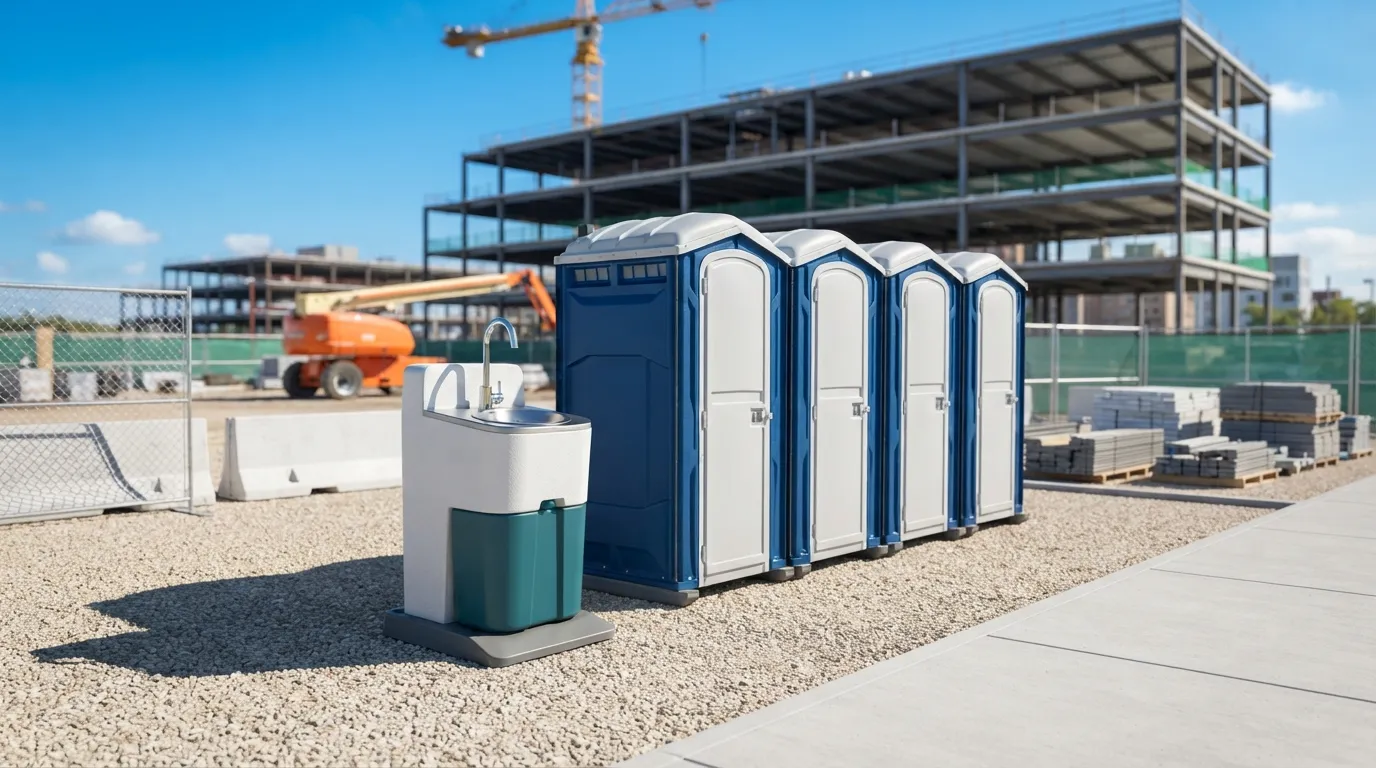
OSHA 1926.51(c) lays out toilet counts by crew size, and it's the number every general contractor in Seattle gets asked about during inspection. Twenty workers or fewer needs 1 toilet facility. From 20 up to 200 workers, you need 1 toilet seat and 1 urinal per 40 workers. At 200 workers or more, that ratio eases to 1 toilet seat and 1 urinal per 50 workers. A 12-person framing crew still needs 1 unit minimum, even though the math rounds under one. A 45-person site crosses into the second bracket and needs 2 toilets and 2 urinals. Worked example: a 90-worker site divides by 40, rounds up, and lands at 3 toilets and 3 urinals. Pair that with OSHA portable toilet requirements for the full breakdown, and check how many porta potties do I need style guidance against your actual trade mix, since electricians and painters bring different exposure questions. If your crew is spraying coatings or using herbicides or insecticides, OSHA 1926.51(f)(1) requires washing facilities on top of toilets, a separate obligation from the toilet count itself. For general jobsite sanitation and potable water, 1926.51(a)(1) also applies. A standard porta potty rental covers most trade crews; a construction site services package bundles toilets with fencing and dumpsters for larger sites around Seattle.
How Many Porta Potties for an Event?
Events run on a different formula than jobsites, because people show up in waves instead of clocking in for eight hours straight. The rough industry guide is 1 unit per 50 guests for a 4-hour event, then you add units for longer days or heavier drinking. A wedding of 120 guests over 5 hours needs roughly 3 standard units, or step up to a deluxe flushable porta potty for a nicer feel near the reception tent. Add alcohol and that ratio tightens, since bar lines and beer are hard on restrooms; plan closer to 1 per 35-40 guests when drinks are flowing. Multi-day festivals need a service plan, not just more units, since ANSI/PSAI Z4.3 sets a baseline of one service visit per week for up to 10 users over a 40 hour week, and festival crowds blow past that fast. A 300-person outdoor concert over two days might run 8-10 standard units plus 1 ADA unit, serviced daily rather than weekly. Browse event restroom rental or festival restroom rental options, and see wedding restroom rental for tent-side deluxe upgrades.
Do I Need an ADA-Accessible Unit?
Yes, if you're clustering portable toilets for public use. ADA Standards section 213.2 requires that at least 5 percent of clustered single-user units be accessible, and never fewer than one unit even if your event is small. That means a 20-unit event site needs at least 1 ADA unit, and a 4-unit jobsite still needs 1. The ADA unit needs a 60 inch turning circle per section 304.3.1, a 32 inch clear door opening per 404.2.3, and a 36 inch clear route per 403.5.1 to get there. Surfaces need to be stable and slip resistant under 302.1, which matters during Seattle's wetter months given the region averages 91.0 days a year with 0.10 inch or more of precipitation. Reach ranges for dispensers and locks follow 308.2.1, and operable parts need to work with one hand and 5 pounds of force or less under 309.4. Check ADA accessible porta potty for unit specs, and ADA restroom requirements for the full standard.
How Does Multi-Day or Long-Term Rental Change the Count?
Longer rentals need more service, not necessarily more units, if you plan the pump schedule right. A standard unit holds 60 to 70 gallons in its tank, and ANSI/PSAI Z4.3's baseline of one weekly service for 10 users over 40 hours assumes steady, moderate use. A 6-week Seattle renovation project with 15 tradespeople might hold at 1-2 standard units but needs twice-weekly service instead of once. Monthly rentals for ongoing jobsites run on the month column of our pricing rather than a string of daily rates, and that's worth comparing on the monthly porta potty rental page. For a job that stretches past a season, ask about a porta potty rental per day versus month tradeoff, since the math flips once you pass roughly three to four weeks. Winter jobs in Seattle need extra attention too, given the average January low sits at 36.9 F and freeze risk to tank contents rises; see porta potty in winter for that adjustment.
What Does It Cost to Rent the Right Number of Units?
| Unit | Day | Week | Month |
|---|---|---|---|
| Standard | $100-$350 | $130-$500 | $125-$325 |
| ADA | $200-$400 | $250-$500 | - |
| Deluxe | $85-$1,200 | $150-$290 | - |
A standard unit runs $100 to $350 a day depending on term length and delivery distance, and weekly rates for a standard unit run $130 to $500. ADA units run $200 to $400 daily, and a multi-day stretch still costs more than a single day once you add the extra service visits. Delivery itself typically adds $100-$150 for a single day trip, though weekend delivery runs higher at $125-$540 given the compressed turnaround. Multiply your unit count from the OSHA table or the event ratio above by the relevant column, then add one delivery fee per trip. Full breakdown on porta potty rental cost, and event-specific pricing runs $200-$800 per unit under the event rate band rather than the daily one.
How Do Dumpster Sizes Relate to My Restroom Count?
Most job sites ordering porta potties also order a roll-off, and the size questions overlap in a customer's head even though the math is separate. A 10 yard dumpster runs about 1,360 cubic feet and suits small cleanouts. So how many feet is a 20 yard dumpster: roughly 20 feet long, and how many cubic feet in a 20 yard dumpster: about 2,720 cubic feet, carrying an estimated 2-3 tons depending on debris type, which answers how many tons does a 20 yard dumpster hold for most household jobs. How many tons can a 30 yard dumpster hold runs roughly 3-4 tons, and a 40 yard box, the largest standard size, holds about 5,440 cubic feet, answering how many cubic feet in a 40 yard dumpster, with how many tons does a 40 yard dumpster hold landing around 4-5 tons on framing or roofing debris. Just like restroom counts scale with crew size, dumpster size scales with job size and demolition weight, not floor square footage alone. See dumpster sizes and dimensions for full charts, 20 yard dumpster rental or 30 yard dumpster rental for booking, and dumpster weight limits before you load concrete or shingles, since overage fees hit hard.
Where Should I Place Units on a Seattle Job Site or Event?
Placement drives both your unit count and your permit obligation, and Seattle treats the two separately. If you're placing a storage container or residential dumpster in the public right-of-way, SDOT requires a Street Use permit under Seattle Municipal Code 15.04.010 before delivery, filed through the Seattle Services Portal with a Right-of-Way Impact Plan attached. Whether a portable toilet specifically needs a named SDOT permit type isn't confirmed in SDOT's published categories, so placement in the right-of-way needs a direct check with the city before delivery day. Legal parking-space placements for containers must sit at least 30 feet from intersections, 10 feet from driveways and 15 feet from fire hydrants, and that same clearance logic is worth applying to toilet placement even without a confirmed permit type. On private property in Seattle, you skip that question entirely. See porta potty placement guide and porta potty permit requirements before finalizing your site plan, and request a quote once you know your count.
How many porta potties do I need for 100 people?
Plan on 2 standard units for 100 guests over a 4-hour event, using the 1-per-50 guideline. Stretch the event past 4 hours, add alcohol, or run it over two days and that count climbs toward 3-4 units plus 1 ADA unit under ADA 213.2.
How many tons does a 30 yard dumpster hold?
A 30 yard dumpster typically carries around 3-4 tons, depending on material density. Concrete and shingles hit weight limits fast; lighter debris like wood framing lets you fill more volume before hitting the ton cap. Check dumpster weight limits before loading.
How many cubic feet are in a 10 yard dumpster?
A 10 yard dumpster holds about 1,360 cubic feet. That's roughly 12 feet long, sized for small cleanouts, single-room remodels or a modest yard debris haul. See 10 yard dumpster rental for dimensions and booking.
Do I need more toilets if serving alcohol at an event?
Yes. Alcohol shortens the interval between bathroom trips and creates longer lines, so tighten your ratio from 1-per-50 to roughly 1-per-35-40 guests. A 150-person wedding with a full bar should plan closer to 4-5 standard units rather than 3.
What size dumpster do I need for a kitchen remodel?
Most kitchen remodels fit a 20 yard dumpster, which holds about 2,720 cubic feet and 2-3 tons. Cabinet demo, drywall and flooring debris fill it without exceeding weight limits on most standard hauls. See 20 yard dumpster rental.
Does a multi-day festival need daily porta potty service?
Yes, in most cases. ANSI/PSAI Z4.3's baseline is one weekly service for light use, but festival crowds exceed that volume in hours, not days. Daily servicing during the event, plus extra units, keeps tanks from overflowing before teardown.
Next step
Get a delivery date
Tell us the address, the dates and the headcount. We size the order and confirm the route.