
How Many Restrooms Does a Race Route Need?
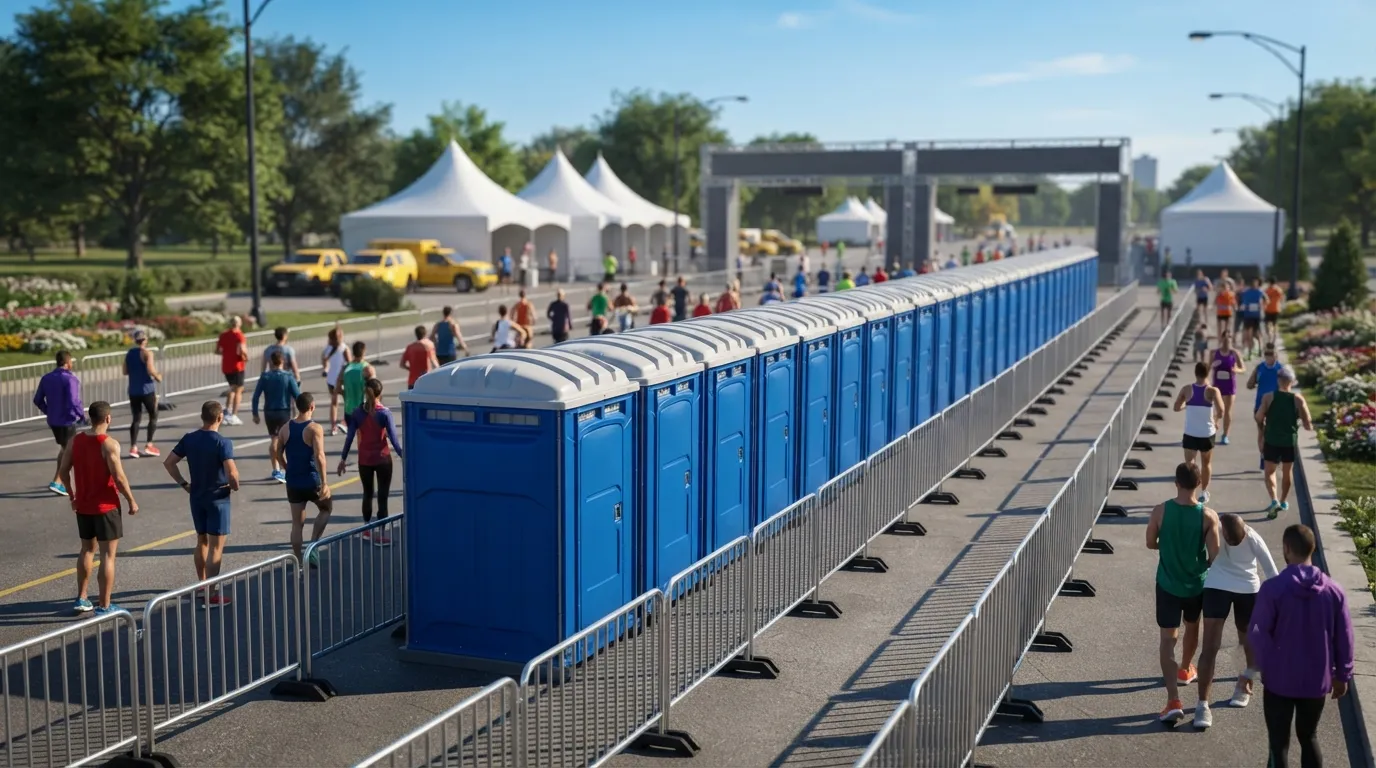
Start with the crowd, not the course. A 5K with 400 runners needs less than a marathon with 8,000, and your finish line festival crowd usually outnumbers the runners. For general sanitation ratios, OSHA 1926.51(c) sets 1 toilet for 20 workers or fewer on a job site, which race organizers often use as a rough planning anchor even though it was written for construction crews, not spectators. Most Seattle race directors split units between the start corral, mile markers along the course, and the finish chute, so standard portable toilets get staged in clusters rather than one big bank. If your course runs through Seattle proper versus one of the outer legs toward Mercer Island, 8.9 miles southeast, or Shoreline, 11.8 miles north, your delivery routing changes and that affects how many trucks you need on the ground before gun time. Bigger races add ADA accessible units at every cluster point, since ADA Standards section 213.2 requires at least 5 percent of clustered single-user units to be accessible, with a minimum of one regardless of cluster size. If your finish line features a beer garden or a VIP tent, a deluxe flushable unit or a full restroom trailer reads a lot better in event photos than a plain bank of units. Use our porta potty calculator guide to work out your exact count before you call.
What Does Race Day Setup Actually Involve?
Setup for a marathon is not the same job as dropping one unit at a job site. You are placing restrooms along a moving route, often on public streets, and Seattle treats work in the public right-of-way as something that needs sign-off before it happens. Under Seattle Municipal Code 15.04.010, using any public place without a written permit from SDOT, from Seattle Department of Construction and Inspections, or from the Superintendent of Parks and Recreation is unlawful, and SDOT states plainly that any work in the right-of-way needs a Street Use permit. SDOT's named permit product covers storage containers and residential dumpsters specifically; whether a portable toilet placement on a closed street falls under that same product or under the general SMC 15.04.010 rule was not confirmed in SDOT's published materials, so confirm placement with the city before you finalize your route map. If your race also needs barricades or crowd control along the course, temporary fencing and crowd control barriers usually get permitted alongside the restroom plan, not separately. Light towers matter for early starts or late finishes in low light, and if your finish festival runs power for timing equipment, sound, or food vendors, you will likely need a temporary power pole staged near the stage or timing tent. Bracing that pole correctly matters just as much as placing it correctly, and it is worth asking your vendor how to brace a temporary power pole before delivery day, not after it is standing: guy it to at least three points at roughly 120 degrees apart, keep the anchor points clear of the runner course and spectator flow, and never let cable runs cross a walking path without matting or elevation. A wet November race morning in Seattle, where the region averages 91.0 days a year with 0.10 inch or more of precipitation, is exactly when a poorly braced pole or an unanchored restroom bank becomes a real hazard.
When Should You Book Restrooms for a Race?
Book as soon as your course map and permit application go in, not after. Race permits, street closures, and restroom placement all get reviewed together in most Seattle event applications, so a late restroom order can hold up the whole approval. Weekend event rates for standard units run in the same band as other short-term event pricing, and if your race weekend needs restrooms Friday through Sunday, that is a different rate than a single training-run rental. For any race with a finish festival, a restroom trailer rental or a 4 stall restroom trailer gives VIP sponsors and race staff something nicer than a standard unit, and it services faster between waves of finishers.
| unit | day | weekend | event |
|---|---|---|---|
| standard | $100-$350 | $125-$400 | $200-$800 |
| ada | $200-$400 | $199-$300 | - |
| trailer | $175-$2,500 | $900-$3,000 | $2,499-$3,899 |
What size race needs a restroom trailer instead of standard units?
Once your finish festival tops a few thousand attendees, or you are running a ticketed VIP area, a trailer reads better and handles line pressure faster than a bank of standard units. Check our restroom trailer rental cost guide before locking your budget.
Do you deliver restrooms along a closed race course, not just to one address?
Yes. We stage units at multiple points along a route, coordinated with your course marshals and your permit timeline, the same way we handle multi-point delivery for festival restroom rental and concert restroom rental clients.
How far in advance do you need our final headcount?
Give us your projected runner and spectator count as soon as your permit is filed. Counts shift race week, but early numbers let us reserve trucks and units before other Seattle events book the same weekend.
Can restrooms be removed and reset for a multi-day race weekend?
Yes. We can pull units after a Saturday shakeout run and reset a fresh bank for Sunday's marathon, which usually costs less than paying for standing rentals across the full weekend. Ask about weekend pricing when you request a quote.
What happens if my race route crosses into a neighboring city?
Routes that cross into SeaTac, 15.3 miles south, or Issaquah, 16.7 miles east, may need separate permit coordination with that city. Tell us your full route and we will flag any jurisdiction changes before delivery. See our service areas page for coverage details.
Next step
Get a delivery date
Tell us the address, the dates and the headcount. We size the order and confirm the route.